
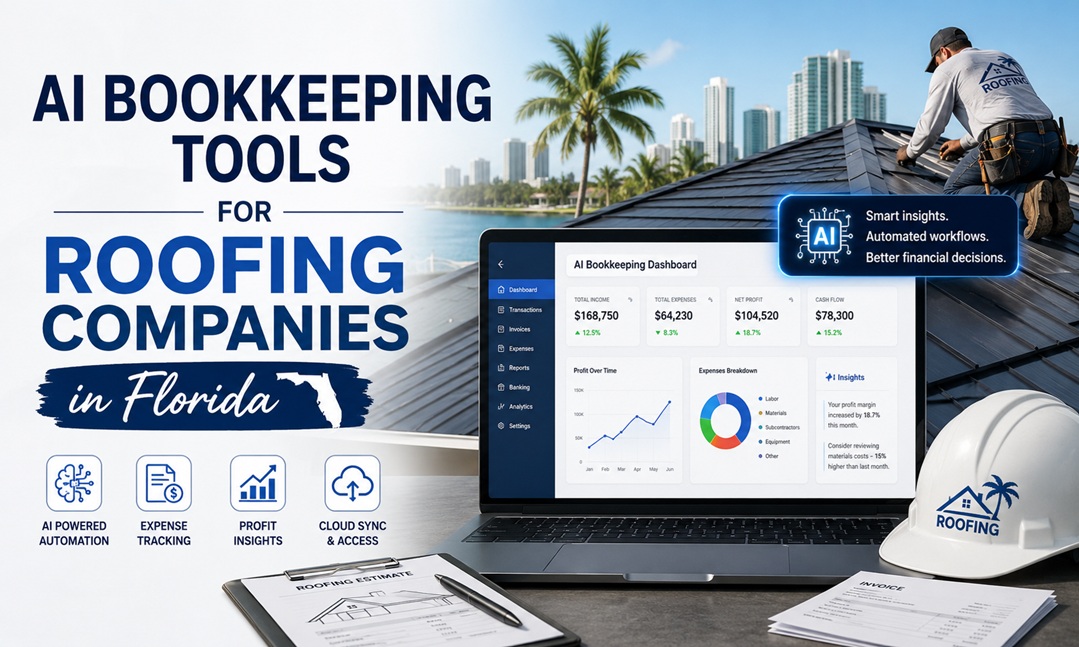
Running a roofing company in Florida is nothing like running one in Ohio. Hurricane season creates violent cash flow swings, insurance billing complexity is off the charts, and your crew is often spread across multiple job sites in different counties. Generic accounting software wasn’t built for any of this — which is exactly why AI bookkeeping tools for roofing companies in Florida have become genuinely useful, not just a tech trend.
The tools that work best in this market are ones that handle job costing at the project level, integrate with roofing CRMs like AccuLynx and JobNimbus, and manage the multi-invoice complexity that comes with insurance restoration work. QuickBooks Online with AI add-ons, Buildertrend’s financial module, and Knowify are the top contenders for most Florida roofing contractors.
Why Florida Roofing Companies Need Specialized Bookkeeping
- Hurricane season creates a surge-and-drought cash flow pattern unlike most industries
- Insurance restoration jobs require line-item billing that syncs with adjuster estimates (Xactimate)
- Multi-crew, multi-site operations need job-level profit/loss tracking, not just company-wide figures
- Florida’s contractor licensing requirements create compliance reporting needs
- Seasonal labor costs (especially post-storm) are difficult to track without automated time/job allocation
Best AI Bookkeeping Tools for Florida Roofers
| Tool | Best For | AI Features | Price Range/Month |
| QuickBooks Online + AI Assist | Overall accounting, small-medium firms | Receipt capture, categorization, anomaly detection | $30–$200 |
| Buildertrend Financial | Large project tracking | Job cost forecasting, budget alerts | $199–$499 |
| Knowify | Specialty contractors | AI job costing, progress billing | $149–$299 |
| Sage Intacct Construction | Mid-to-large firms | Automated reconciliation, AI reporting | $400+ |
| FreshBooks with Gusto | Small crews, self-employed | Expense AI, payroll integration | $60–$120 |
QuickBooks Online: The Florida Roofing Standard
Most Florida roofing companies eventually land on QuickBooks Online because their accountants know it and it connects to the most integration partners. The newer AI features — including automated expense categorization, receipt scanning via mobile, and the ‘Ask QuickBooks’ natural language query feature — have meaningfully reduced manual entry time.
For insurance restoration work specifically, pairing QBO with an Xactimate integration (through a middleware like Xactimate’s API or a tool like RoofSnap) creates a near-seamless billing workflow for storm jobs.
Job Costing: The Function Florida Roofers Can’t Skip
Knowing your company’s overall profit isn’t enough. You need to know which specific job types — commercial flat roofs, residential shingle, insurance replacements, tile repair — are actually profitable, and which are eating margin.
AI job costing tools like Knowify or the job tracking layer in Buildertrend automatically allocate labor, materials, and overhead to each project as you go. By the time a job closes, you have a real picture of what you made — not a surprise when your bookkeeper catches up three months later.
Pro Tips for Florida Roofing Bookkeeping
Set up a dedicated insurance proceeds holding account in your QBO chart of accounts. Mixing storm insurance payments with regular revenue creates a distorted picture of your business’s financial health and complicates tax season considerably.
Use AI receipt capture religiously in the field. Jobsite material runs, fuel, equipment rental — these are the expenses that disappear without a trace when a crew member doesn’t submit receipts. Apps like Dext (formerly Receipt Bank) and QuickBooks’ mobile capture work well and your bookkeeper will appreciate you for it.
Common Mistakes to Avoid
- Using a generic small business accounting tool without job costing capability
- Not tracking insurance proceeds separately from service revenue
- Relying on year-end reconciliation instead of real-time job cost monitoring
- Ignoring the post-hurricane bookkeeping backlog until January — catch up monthly
- Not integrating your bookkeeping tool with your roofing CRM — double-entry creates errors
FAQ
Q: What accounting software do roofing companies use in Florida?
A: QuickBooks Online is the most common, followed by Buildertrend’s financial module for larger operations. Knowify is growing among mid-size contractors for its job costing features.
Q: Can AI bookkeeping tools handle insurance restoration billing?
A: Yes — especially when integrated with Xactimate. Tools like QBO with custom line-item invoicing and Knowify’s progress billing features are well-suited to insurance job complexity.
Q: How much does AI bookkeeping software cost for a roofing company?
A: Expect $100–$400/month for a mid-size roofing company, depending on crew size and feature needs. The time savings on manual entry typically justify the cost within months.
Florida roofing is a great business — but the financial complexity is real. The right AI bookkeeping tool won’t replace your accountant, but it will give them (and you) clean, real-time data to work from. Job costing, storm-season cash flow management, and insurance billing integration are the three things to prioritize when choosing your platform.