
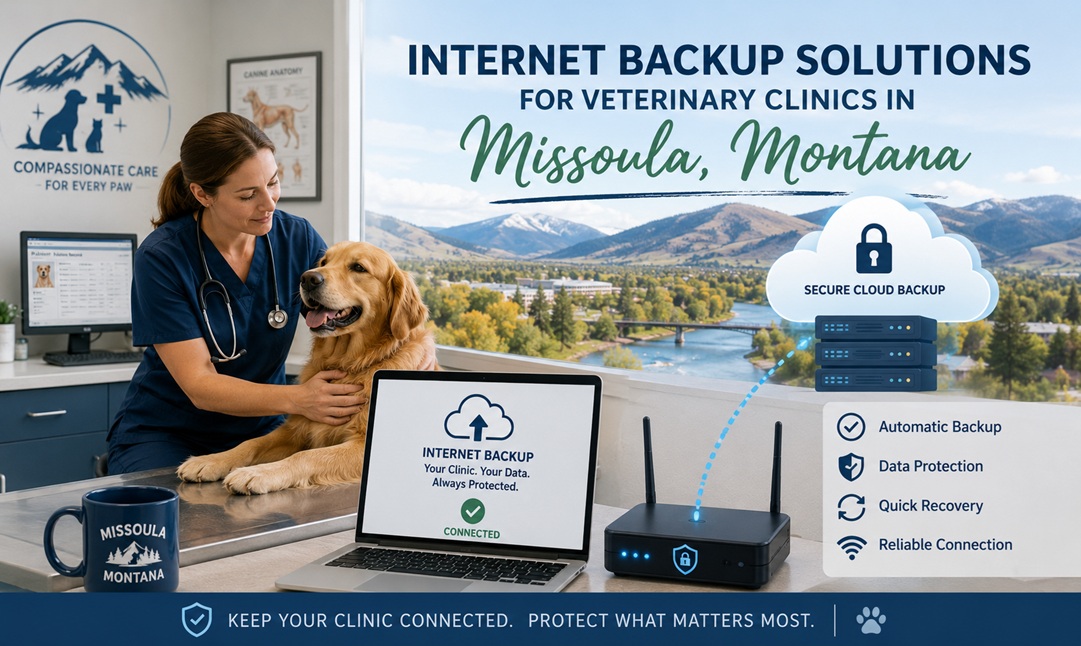
The Outage That Sparked a Conversation
A veterinary clinic on the south side of Missoula went dark for four hours on a Tuesday morning in late winter. Not a power outage — the lights stayed on. Their internet provider had an upstream failure, and suddenly the practice management software was inaccessible, payment terminals wouldn’t process, and the electronic health record system for morning appointments was effectively a wall. Staff had to work from handwritten notes and turn away two scheduled imaging patients who required online result submission.
That scenario isn’t unique to this clinic. It’s a common enough story among Missoula’s small veterinary practices, where a single internet service provider connection is often all that sits between smooth operations and an improvised morning.
What That Outage Revealed
Three things stood out from that experience. First, the clinic had no documentation of what processes actually required live internet versus what could function locally on cached data. Second, there was no secondary connection — not even a mobile hotspot arrangement. Third, recovery time wasn’t a matter of the ISP fixing the problem; it was a matter of the clinic realising the ISP had a problem at all. Forty minutes passed before anyone confirmed the outage wasn’t an internal IT issue.
These gaps are fixable, and fixing them doesn’t require a large IT budget. But it does require treating internet connectivity like a utility rather than an assumption.
Lessons for Missoula Vet Clinics
Missoula’s geography creates specific connectivity realities. The city has decent fibre coverage in its core commercial districts — the areas around Brooks Street and Reserve Street where many clinics are located benefit from this — but the surrounding areas, including the Rattlesnake corridor and the Orchard Homes neighbourhood, can be more limited. Cellular backup is viable here because T-Mobile and Verizon both have reasonable Missoula coverage, but rural satellite options (Starlink in particular) have also entered the conversation for clinics on the city’s edges.
The practical hierarchy for most Missoula vet clinics: a primary fibre or cable business internet connection paired with a 4G/5G cellular failover router that switches automatically on outage detection. Devices like those from Peplink, Cradlepoint, or Digi International are purpose-built for this — they monitor both connections continuously and switch over in seconds rather than minutes.
Concrete Recommendations
- Map your critical systems first. Know which software requires live internet versus which can function briefly on cached credentials or local network.
- Install a cellular failover router — not just a hotspot you have to manually activate. Automatic failover is the difference between a five-second disruption and a four-hour one.
- Contact Northwest Communications or Blackfoot Telecommunications about business-grade redundancy options. Both serve the Missoula area and understand local infrastructure.
- Maintain a laminated emergency protocol sheet at the front desk: what to do if internet drops, who to call, what can proceed manually.
- Test your failover quarterly. A backup that hasn’t been tested isn’t a backup — it’s an assumption.
Connectivity resilience for a veterinary clinic in Missoula isn’t an IT luxury. It’s standard practice risk management. The investment is modest relative to the revenue lost in even a two-hour outage.