
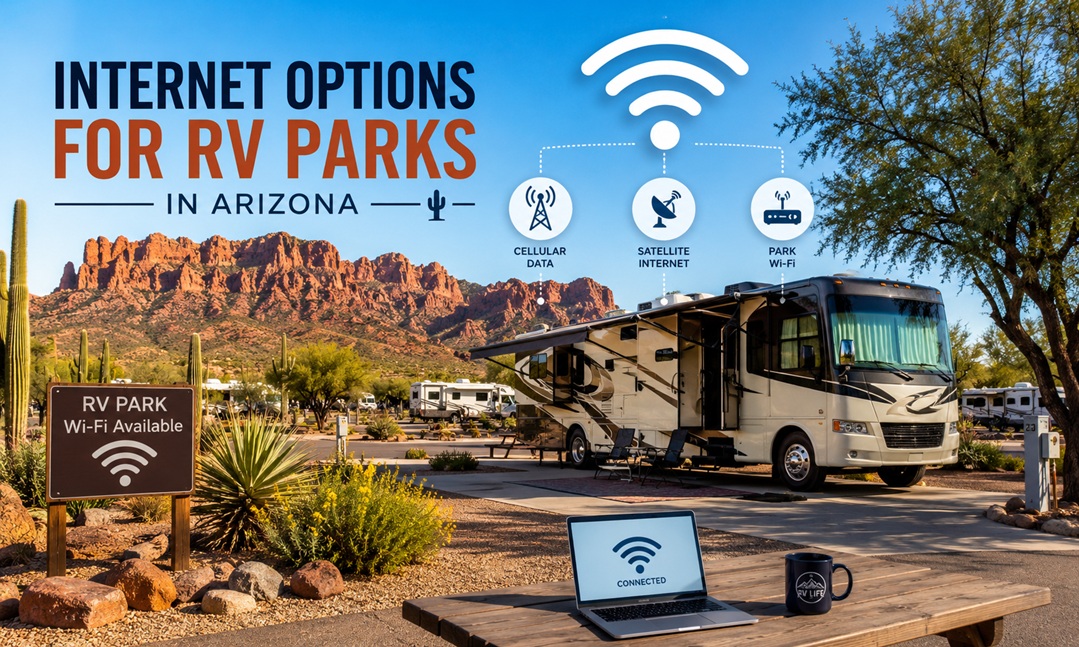
Arizona RV parks offer spectacular scenery and serious connectivity challenges in almost equal measure. Whether you’re parked near Sedona’s red rocks, tucked into the Sonoran Desert outside Tucson, or wintering in the Phoenix metro, the internet situation at any given park can range from perfectly adequate to completely non-functional.
Here’s what actually works for getting reliable internet at Arizona RV parks — based on how the state’s geography, cell coverage, and park infrastructure actually look.
Why Internet at Arizona RV Parks Is Trickier Than You Think
The problem isn’t just remoteness. Even urban-adjacent Arizona RV parks — places 20 minutes from Phoenix or Tucson — suffer from overcrowded shared park WiFi, spotty cellular coverage in canyon areas, and the particular challenge of desert terrain that disrupts signals differently than flat or forested landscapes.
Full-time RVers and snowbirds who rely on internet for work face a real planning challenge. The solution almost always involves layering multiple options rather than relying on any single source.
Best Internet Options for RV Parks in Arizona
Starlink RV — Is It Worth It in Arizona?
For most Arizona RV users, Starlink RV is the most reliable single option available. Satellite-based internet bypasses cellular coverage gaps entirely, making it effective in remote desert locations where no carrier has meaningful signal.
The honest trade-offs: Starlink RV costs around $150/month (portable plan) plus hardware. It underperforms in heavy rain — which matters less in Arizona than most states. Performance in dense RV parks with many users can degrade.
For full-timers or extended-stay Arizona snowbirds, it’s often worth the investment. For weekend campers, the economics usually don’t pencil out.
Cellular Data Plans (Verizon, T-Mobile, AT&T)
Verizon historically has the best rural Arizona coverage, particularly important for areas like the White Mountains, Navajo Nation adjacent parks, and remote southeastern Arizona. T-Mobile’s expanded rural network has become genuinely competitive in the I-10 corridor and Phoenix/Tucson areas.
AT&T performs well in Arizona’s urban parks and along major highways.
Practical tip: Check carrier-specific coverage maps for the exact county where you’ll be parked — not just the general region.
Mobile WiFi Hotspots
Dedicated hotspot devices from Verizon, T-Mobile, or unlocked devices with high-capacity SIM cards give you a personal, secure connection that isn’t shared with 40 other park guests. This is often the best approach for moderate data users who park primarily in cellular-covered areas.
RV Park-Provided WiFi — When to Trust It
Short answer: rarely. Park WiFi in Arizona — like virtually everywhere — is shared bandwidth divided among dozens or hundreds of users. It works adequately for light browsing during off-peak hours. Streaming, video calls, or work-from-RV use cases almost always overwhelm it.
Think of park WiFi as a backup, not a primary.
Signal Boosters for Rural Arizona Spots
A cellular booster (WeBoost or SureCall are the established brands) amplifies existing signal — useful for parks where you get one or two bars of cellular. It won’t create signal where none exists.
For Arizona’s canyon and desert terrain specifically, a booster is worth carrying even if it’s not your primary solution. They work when they work.
| Option | Monthly Cost | Speed (approx) | Best For | Arizona Desert Reliability |
|---|---|---|---|---|
| Starlink RV | ~$150 | 50–200 Mbps | Full-timers, remote sites | Excellent |
| Verizon hotspot | $50–$80 | 10–50 Mbps | Covered areas, moderate use | Good (urban/highway) |
| T-Mobile hotspot | $35–$65 | 10–100 Mbps | Phoenix/Tucson corridor | Good |
| Park WiFi | Included | 1–10 Mbps | Light backup only | Poor–Moderate |
| WeBoost signal booster | ~$500 one-time | Amplifies existing | Rural coverage areas | Variable |
Best Arizona RV Parks With Strong Internet Infrastructure
A small but growing number of Arizona RV parks have invested in proper high-speed WiFi infrastructure — fiber-connected, with sufficient bandwidth for genuine work-from-RV use.
When researching parks, check reviews specifically mentioning internet speed on RV-focused platforms like Campendium or The Dyrt. These communities tend to give honest, specific connectivity feedback rather than general ratings.
Phoenix metro area parks generally have the most reliable park WiFi due to infrastructure investment. Sedona and Jerome area parks are reliably poor for park WiFi — plan around that with your own cellular or Starlink.
Pro Tips: Managing Data and Connection Quality on the Road
- Check carrier coverage maps before you route, not after. Download offline maps for Arizona before leaving cellular coverage areas.
- Use data management apps. For cellular hotspot users, apps that track usage by device prevent bill shock in unlimited-but-throttled plans.
- Starlink portability is genuinely useful in Arizona. The dish sets up in minutes and the service transitions between sites automatically. If you’re moving parks frequently, the portability tier is worth the premium over fixed-address Starlink.
- Combine cellular + Starlink with a router. Travel routers (GL.iNet, Pepwave) let you switch seamlessly between Starlink and cellular as conditions change — maintaining your connection without manual switching.
Common Mistakes RVers Make With Internet Setup in Arizona
Relying entirely on park WiFi. Genuinely doesn’t work for anything beyond checking email. Plan accordingly.
Choosing carriers based on home address coverage. Arizona’s rural coverage landscape is completely different from suburban coverage in most states. Recheck before you travel.
Not testing Starlink at the actual site. Trees, canyon walls, and certain park orientations can obstruct the sky view needed for Starlink. Check the app’s sky-view tool before setting up.
FAQ
Does Starlink work at Arizona RV parks? Generally yes, including remote desert sites. Performance is best with a clear southern sky view — obstructions from canyon walls or tall trees can affect reliability. Urban and suburban Arizona parks work well.
Which cell carrier has best coverage in rural Arizona? Verizon leads for remote rural Arizona coverage, particularly in the eastern and northern regions. T-Mobile is competitive in the I-10 and I-17 corridors. AT&T performs well near major cities.
Can I work remotely from an RV park in Arizona? Yes, reliably — with the right setup. Starlink or a high-capacity cellular hotspot with a signal booster covers most Arizona work-from-RV scenarios. Don’t plan video calls from remote canyon parks without Starlink.
Arizona is one of the best RV states in the country and one of the more challenging for internet connectivity. The solution isn’t finding one perfect option — it’s building a layered setup that handles different scenarios. Starlink for remote desert sites, cellular hotspot for covered areas, park WiFi as occasional backup. That combination covers virtually everything Arizona will throw at you.